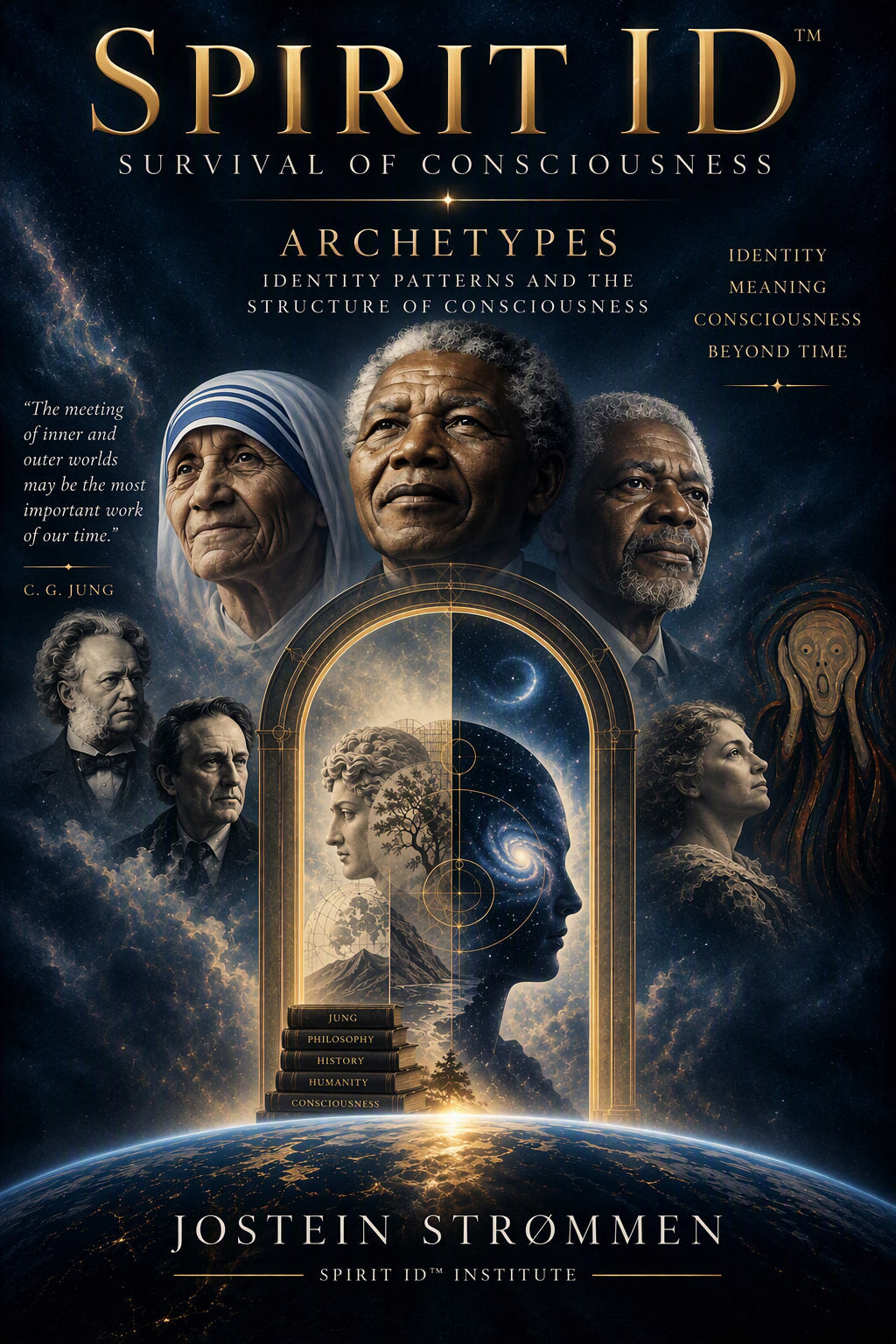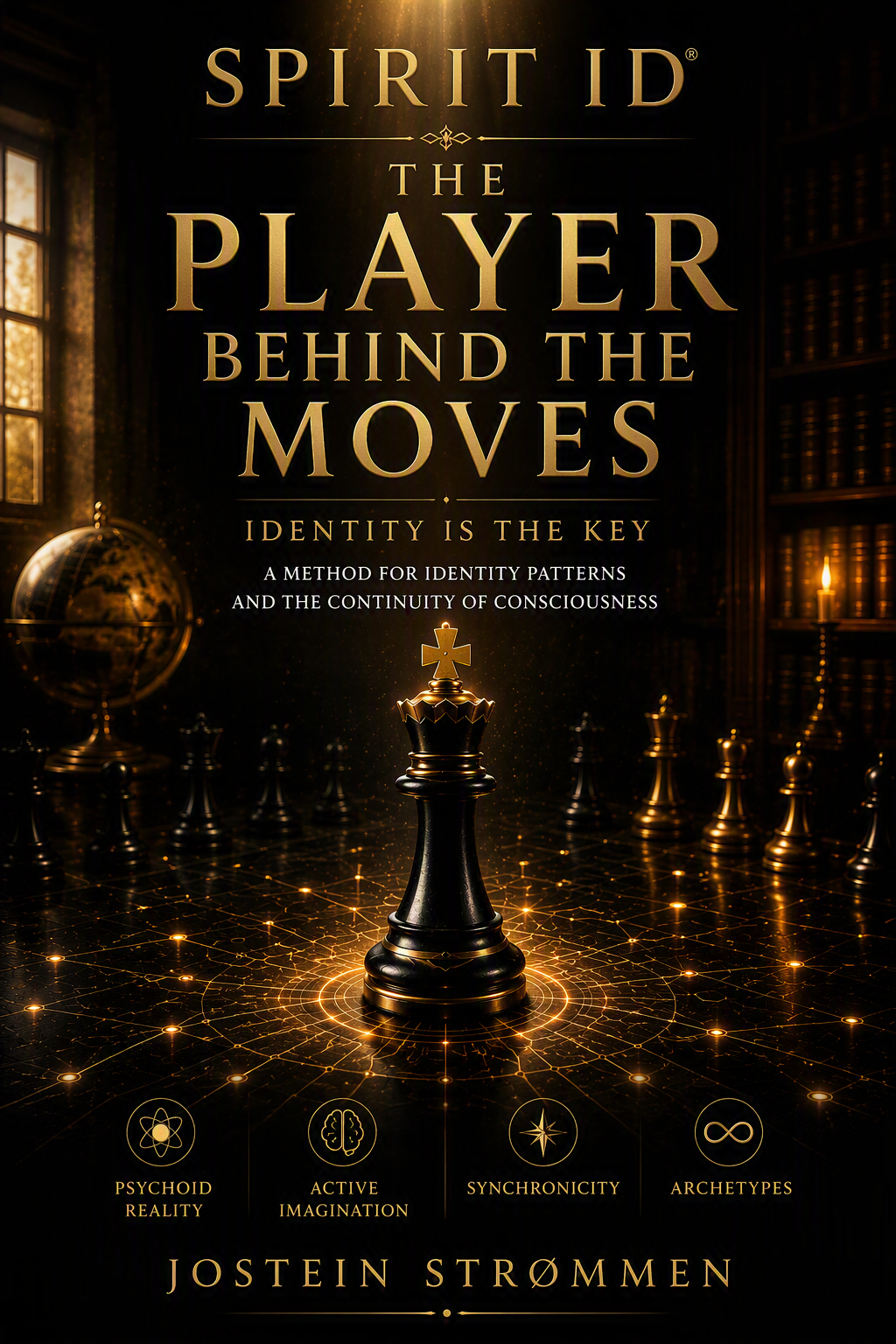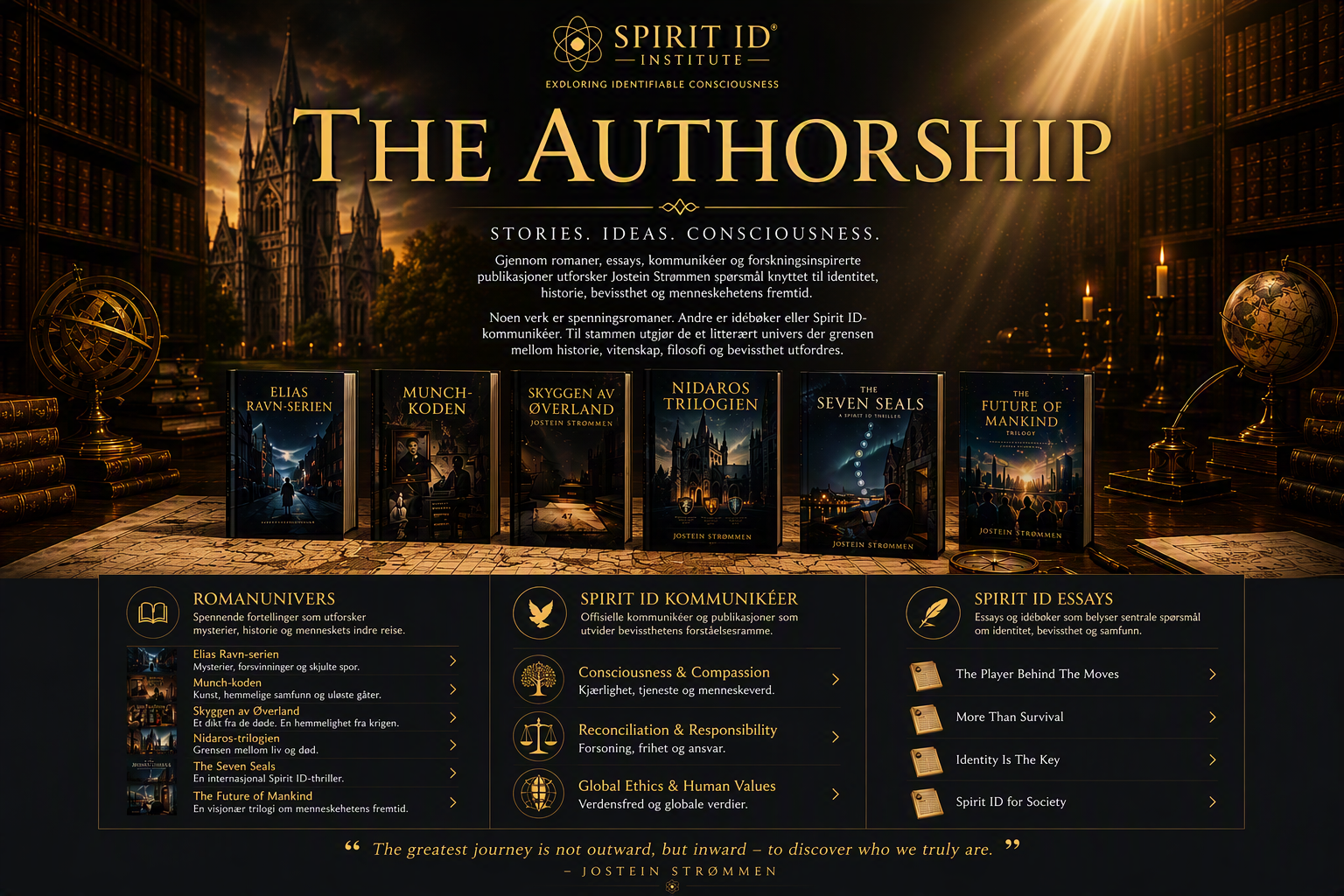
A scientific framework for verifying the continuity of consciousness
Metapsychics provides the structural bridge between theory and observable evidence — linking psychoid dynamics, PK‑based responses, and identity‑level information into a unified method of empirical verification. The framework below outlines how these components converge into a single, testable model.
Spirit ID™ is your new DNA — the enduring identity pattern beyond the physical body.
Your consciousness continues, and what survives is a signature greater than form or biology.
That signature is your Spirit ID.
Spirit ID Case™
Spirit ID Case™ Pilot
The first documented case within the Spirit ID™ system, combining internal signature analysis (Spirit ID) with external stimulus–response verification (PK Duality).
This Pilot Case demonstrates how linguistic consistency across a 10‑text corpus and predefined PK yes/no responses (1 thud = YES, 2 thuds = NO) can be documented within a unified method framework.
A foundational demonstration of the full Spirit ID chain:
Spirit ID™ → Spirit ID Method™ → Spirit ID Duality™ → Spirit ID Proof™ → Spirit ID Case™
Metapsychics SCIENCE™
Metapsychics Framework Validation
A unified model connecting Jung’s psychoid concept with the PK Protocol, Spirit ID Duality, and empirical validation through cold-case correlation. This framework demonstrates how non‑representable consciousness can manifest observable physical signals and verifiable identity.
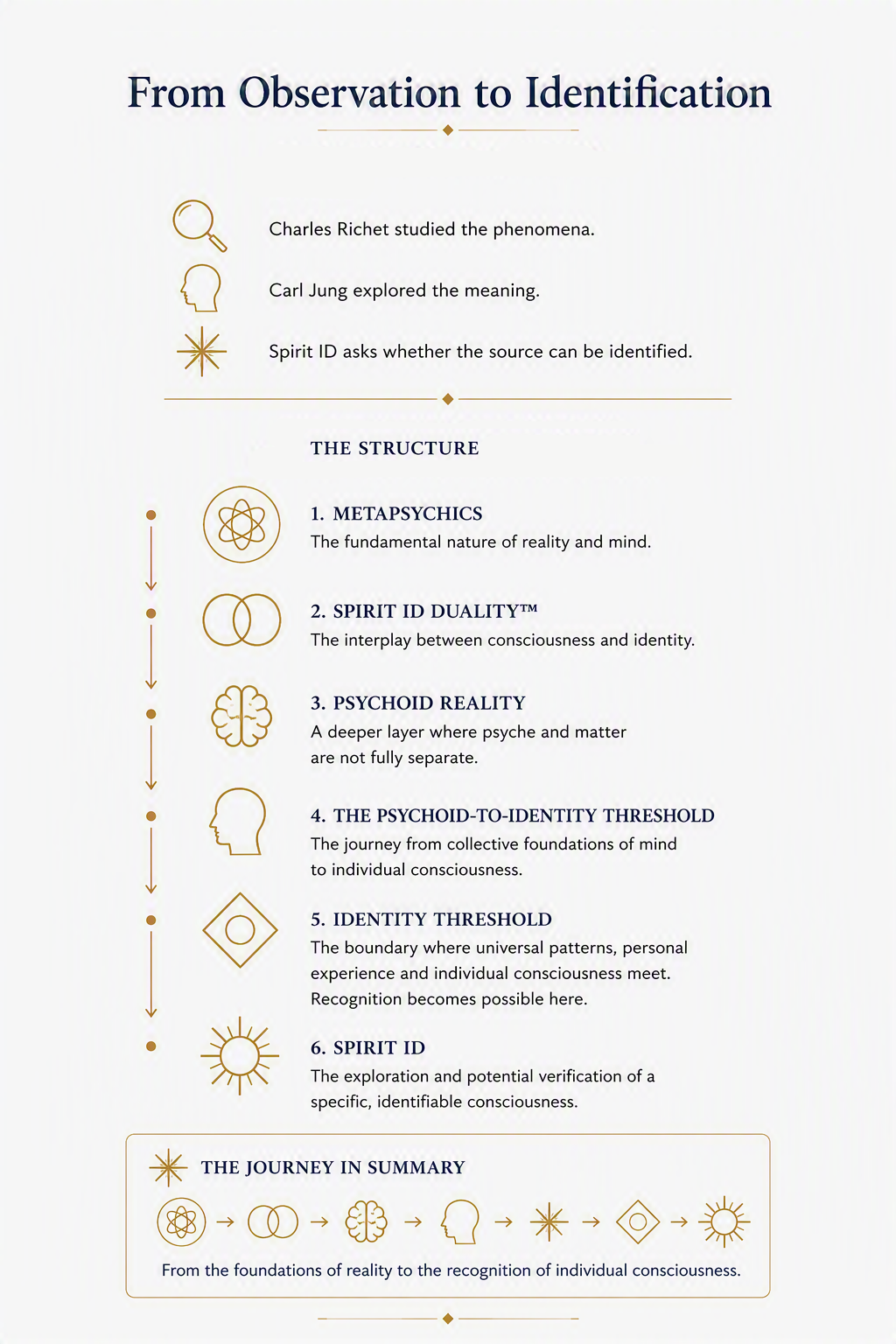
Diagram
The following diagram illustrates the full conceptual structure linking Jung, PK, Spirit ID, Duality, and Cold Case verification:

Metapsychics SCIENCE™
Spirit ID™ — A clarity‑based system for recognising identity‑level patterns in altered states
Spirit ID focuses on one core idea: that inner responses can show structure. Through clarity‑based language flow, long‑term signature patterns and controlled binary verification, the method separates stable internal signals from ordinary mental noise.
The goal is not belief, but documentation — a disciplined approach where impressions, tone, and structural coherence are analysed over time, and only what can be independently verified is considered evidential.
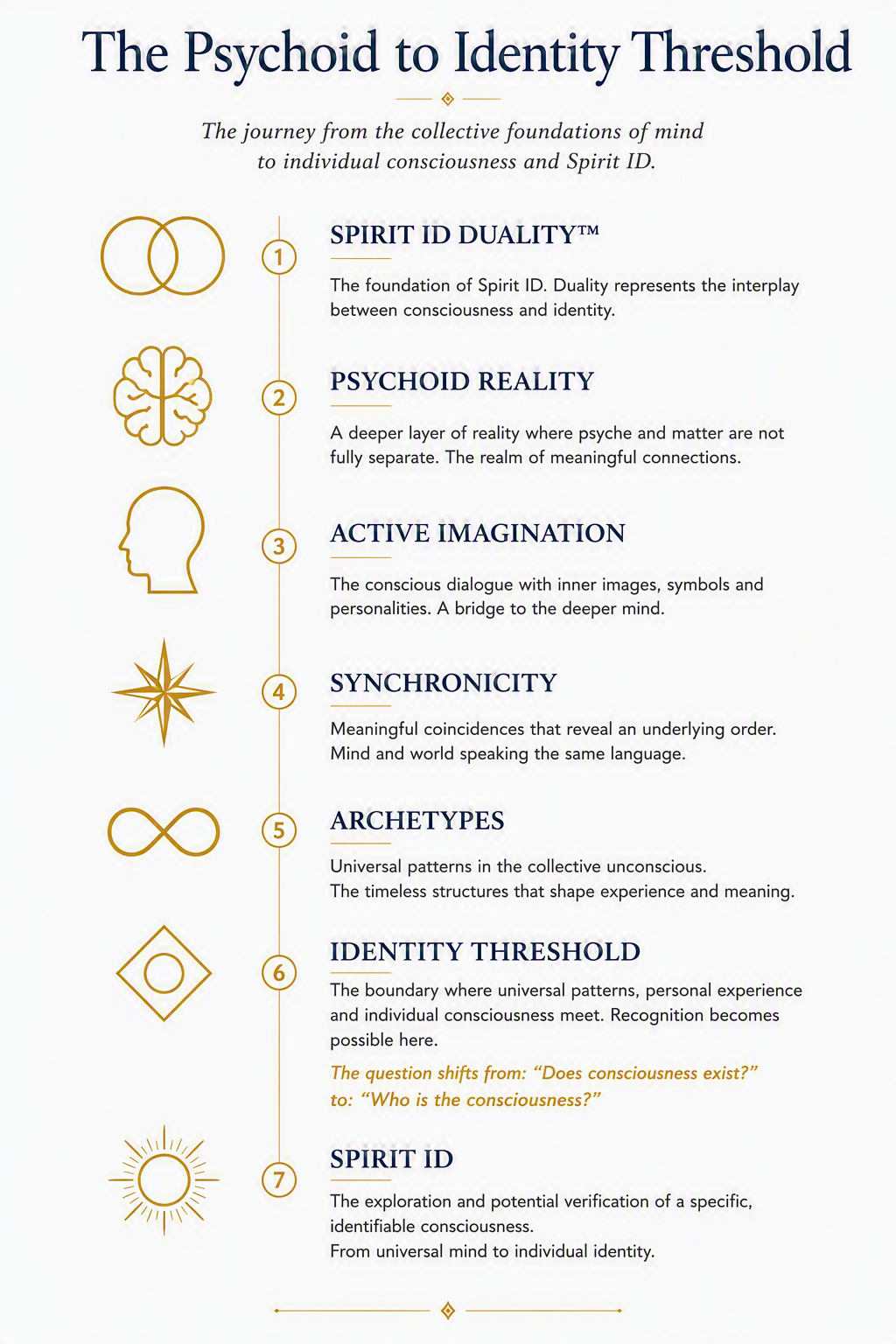
C.G. Jung — Psychoid and the Spirit ID Duality™
Spirit ID builds on Jung’s descriptive approach to border phenomena and his insight into the psychoid — the threshold where inner and outer experience meet. Jung’s view of the unconscious as a dynamic field, rather than a container of fixed contents, provides a historical reference point for understanding mind–matter boundary events.
Spirit ID Duality™ advances this perspective by separating internal impressions from external non‑evidentiary impulses, and by requiring independent verification before any claim is considered evidential. In this way, Spirit ID continues Jung’s methodological restraint while offering a modern structural framework for evaluation.
Spirit ID™
A modern consciousness‑based identification system.
Consciousness Research at the Foundation is built on two complementary areas:
- 1. Spirit ID Method™ (modern) — a structured system for analysing altered‑state clarity flow, subconscious emergence, tone, long‑term identity‑signature patterns and the dual‑system model known as Spirit ID Duality™.
- 2. Metapsychics Research (historical) — earlier exploratory material and archival documentation reflecting the developmental phase leading up to the modern method.
By presenting both areas side by side, readers can follow the development of methods, observations and insights without requiring prior knowledge of the field. The modern Spirit ID framework provides structure and verification, while the historical archive offers context and background.

Spirit ID is a structured method for recognising internal clarity patterns, signature impulses and identity‑like coherence within controlled altered states of consciousness. The full method and its framework are presented in the book Spirit ID.
Spirit ID Method™
This section introduces a modern approach to non‑physical communication. The focus is on clarity, consistency and structured signals that can be observed and evaluated over time. Spirit ID is presented as a disciplined methodology—one based on documentation, stability and repeatability—rather than assumption or belief.
Metapsychics Research
This section explores both historical and contemporary work related to Trance, Telepathy, PK/Telekinesis and other phenomena traditionally associated with Metapsychics.
It includes original material and archival sources illustrating how investigators have approached these questions over time.
A Unified Purpose
Across these areas, the aim remains the same: to explore consciousness through observation, documentation and comparison, and to understand what these phenomena may suggest about the deeper nature of human existence.
Together, this material forms a living archive—an evolving space where methods can mature, insights can accumulate and new connections can emerge. Rather than presenting final answers, Consciousness Research provides a foundation for ongoing inquiry, encouraging scientific curiosity and open‑minded reflection.
Academic Framework: Documentation and Evidence‑Based Inquiry
Although the subject matter involves non‑physical phenomena, the methodology emphasizes structured documentation, transparency and replicability—principles aligned with academic standards.
Systematic Documentation
All observations—whether experiential, symbolic, physical or intuitive—are recorded in a structured manner:
- Time‑stamped logs of impressions and events
- Separation of raw data from interpretation
- Contextual information (environment, state of mind, situational variables)
- Version‑controlled records for long‑term comparison
Comparative and Longitudinal Analysis
Empirical inquiry is supported through:
- Longitudinal comparison of recurring features over time
- Cross‑case correlations across different contexts
- Internal consistency checks between new and earlier data
Empirical Orientation
The work focuses on observable patterns, falsifiability where possible, independent verifiability and clear separation between data and hypothesis.
Position Within Broader Scientific Discourse
Consciousness remains one of the least understood areas in science.
This project contributes through:
- Structured first‑person phenomenology
- Transparent research protocols
- Encouraging interdisciplinary dialogue
Integration With Spirit ID
Within Consciousness Research, Spirit ID functions as the methodological core — a clarity‑based system for distinguishing between structured internal responses and unstructured mental noise. While Metapsychics Research documents historical and external phenomena, Spirit ID focuses on reproducible internal processes that can be analysed, compared and evaluated over time.
This dual approach allows the material to remain grounded while still engaging with questions that extend beyond traditional scientific boundaries. The two strands — external anomalies and internal clarity structures — are held separate, yet examined in parallel when relevant patterns emerge.
The Role of Altered States
Altered states of consciousness are approached not as Trance or mediumship, but as controlled conditions for spoken clarity flow — circumstances in which internal language emerges with reduced interference from analytical filtering. All material produced in such states is documented via audio recording and later transcribed for analysis.
The focus is not on the moment of expression, but on the patterns that appear afterwards, when the material is examined for tone, rhythm, coherence, and signature‑level stability. This ensures that all reflections remain within a structured, verifiable framework.
Identity‑Signature Analysis
A central element of Spirit ID is the use of identity‑signature analysis: a systematic method for recognising stable patterns in internal expression.
These include:
- tonal consistency
- conceptual architecture
- emotional coloration
- ethical orientation
- rhythm, pacing and structural coherence
- long‑term stability of expression
This approach avoids speculation and instead emphasises observable features
that repeat across time and context.
Ethical Foundations
Clarity is inseparable from ethics. Every method presented follows strict constraints:
- no predictions
- no private information
- no symbolic interpretations
- no external attribution of authorship
- no claims beyond documented patterns
- complete transparency in process and documentation
This ensures that the work remains responsible, careful and fully grounded.
Why This Research Exists
The purpose of Consciousness Research is not to convince, but to document. It provides:
- a structured archive for ongoing investigation
- a foundation for future interdisciplinary dialogue
- a method for analysing experiences outside conventional frameworks
- a disciplined space where new insights can emerge without premature conclusions
The inquiry is open‑ended by design.
Future Directions
As documentation grows, several areas naturally develop:
- deeper analysis of long‑term signature patterns
- comparative studies between internal clarity states and historical PK archives
- refinement of altered‑state protocols
- integration with academic phenomenology
- development of public educational resources
- ongoing publication of structured findings
Spirit ID itself will continue to evolve as a method, shaped by evidence, clarity and long‑term consistency rather than belief or tradition.
Closing Perspective
Consciousness Research and Spirit ID share a single underlying goal: to bring structure, clarity and responsibility to an area that has long lacked a methodological framework.
By combining modern method, historical documentation and an open but disciplined perspective, this work aims to contribute to a more coherent conversation about human inner life — and what these phenomena may suggest about the deeper nature of consciousness and identity.
The text from known figures is preserved as an impression-based record arising in a non-ordinary or altered state of consciousness.
No identity attribution is made. Any association with known individuals remains hypothetical and unverified.
Within the Spirit ID framework, such material may be examined under Spirit ID Duality™, where impression-based content and independent external verification processes are deliberately separated.
Should independent media analysis, comparative linguistic review, or externally observable dual-response correlations later emerge, such findings would be evaluated separately and without retroactive attribution.
Until such conditions are met, the material remains an impression record only, preserved for its thematic and ethical relevance.